
If you search for the cost of teeth cleaning in Ghana, you will find a few old pages quoting numbers like “GHC 20 to GHC 40.” Ignore them.
Those figures are years out of date and would not cover the cost of the disposable cup the dentist hands you to rinse with in 2026.
The gap between what the internet says and what you will actually pay is wide enough to leave people genuinely confused, and it is the reason this guide exists.
Here is what a professional teeth cleaning really costs in Ghana this year, why the price moves around so much from one person to the next, the difference between an ordinary clean and the deep clean some patients actually need, and whether your NHIS card does anything for you.
No stale numbers, no guesswork.
How Much Does Teeth Cleaning Cost in Ghana in 2026?
A routine professional cleaning — what dentists call scaling and polishing — at a reputable Accra clinic in 2026 typically costs between GHS 200 and GHS 500. That is the realistic band. Where you land inside it depends mostly on one thing: how much hardened tartar has built up since your last visit.
| Type of cleaning | What it involves | Typical cost (GHS) |
|---|---|---|
| Routine scaling + polishing | Standard clean, light to moderate tartar | 200 – 400 |
| Heavy scaling | Significant tartar buildup, longer appointment | 400 – 600 |
| Deep cleaning (scaling + root planing) | Below the gumline, for gum disease | 600 – 1,500+ |
| Cleaning as part of a check-up | Bundled with examination | Often discounted together |
| Children’s cleaning | Gentler clean for younger patients | 150 – 300 |
| Why two people pay different prices for “the same” cleaning: The single biggest factor in your cleaning cost is how long it has been since your last one. Someone who comes every six months has light buildup and a quick, cheaper appointment. Someone who has not seen a dentist in five years has hardened calculus that takes far longer to remove and may need to be split across two visits. The irony of dental cleaning is that the people who avoid it to save money end up paying the most when they finally come in. |
What Is the Difference Between a Routine Clean and a Deep Clean?
This is the distinction that no Ghana competitor page explains, and it is the one most likely to surprise you at the chair. They are not the same procedure, and the price difference is large.
Routine scaling and polishing
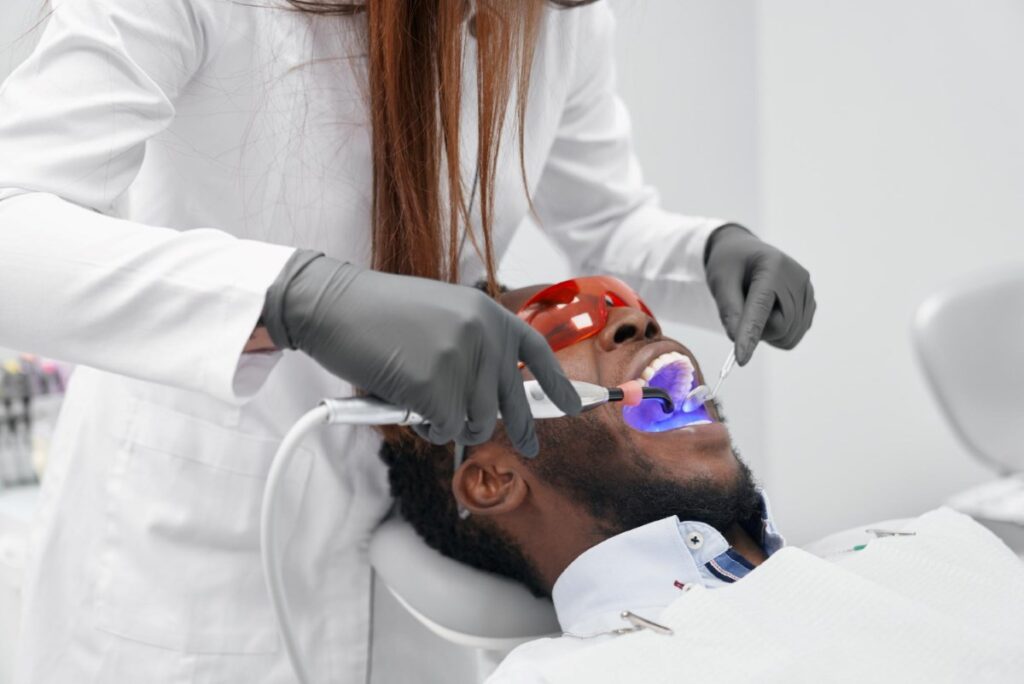
This is the standard cleaning most people need twice a year. The dentist or hygienist uses an ultrasonic scaler to remove plaque and tartar from the surfaces of your teeth and just along the gumline, then polishes to leave the surface smooth.
It is quick, causes little discomfort, and falls in the GHS 200–500 range.
Deep cleaning (scaling and root planing)
This is a treatment, not a routine clean. If you have gum disease, bleeding gums, gum recession, deep pockets between the gum and tooth, bacteria and tartar have spread below the gumline onto the roots.
Deep cleaning removes them and smooths the root surfaces so the gum can reattach. It often requires a local anaesthetic, sometimes more than one visit, and costs considerably more; GHS 600 to GHS 1,500 or beyond, depending on how many areas are affected.
If a clinic recommends a deep clean, ask to see why — the gum pocket measurements or the X-ray. A reputable clinic can show you the evidence.
Be cautious of any clinic that recommends an expensive deep clean to a first-time patient without measuring your gums or taking an X-ray first; that is a known overcharging pattern.
Does NHIS Cover Teeth Cleaning in Ghana?
The National Health Insurance Scheme covers a limited set of dental services, focused mainly on relief of pain and basic treatment, certain extractions, and emergency care.
Routine scaling and polishing for cosmetic or preventive reasons is generally not covered, and you should expect to pay for a routine cleaning out of pocket. Coverage details can change, so confirm with the specific facility and your scheme status before your appointment rather than assuming either way.
How Often Do You Actually Need a Cleaning in the Ghanaian Context?
The global advice is every six months. For many Ghanaians, that advice deserves a local footnote, because diet plays a real role in how fast tartar forms.
- If you drink a lot of sugary soft drinks, sweetened tea, or malt, plaque forms faster, and a six-month interval is the minimum, not a maximum.
- If you chew on hard foods or use chewing sticks alongside brushing, you may have less staining but should still scale twice a year; chewing sticks do not remove tartar below the gumline.
- If you smoke or use tobacco, plan for cleanings every three to four months; tobacco accelerates both staining and gum disease.
- If you have diabetes, more frequent cleaning matters because diabetes and gum disease feed each other.
The cost of staying on a six-month schedule is far lower than the cost of the gum treatment, fillings, and extractions that follow years of neglect. A GHS 300 clean twice a year is cheaper than a single GHS 2,500 root canal caused by decay that started under tartar nobody removed.
Are the Cheap Electric “Tartar Removers” Sold Online Safe?
You have seen them: the handheld ultrasonic “plaque removers” and “calculus scrapers” sold cheaply online and in some shops, promising results at home. As dentists, we see the damage they cause more often than we see results.
The problem is not the idea; it is the lack of training and visibility. Used by an untrained hand, these tools scratch and gouge the enamel, damage the gumline, and can push bacteria deeper rather than removing it.
People also tend to attack the visible front surfaces while completely missing the back surfaces and the gumline where tartar actually matters. The result is enamel damage plus a false sense that the job is done.
If you want to maintain your teeth at home, a good toothbrush, daily flossing, and an antibacterial mouthwash do more good than harm. Leave the scaler to someone trained to use it.
What Happens During a Cleaning Appointment?
- A quick examination of your teeth and gums, and an X-ray if it has been over a year or if there are signs of trouble.
- Ultrasonic scaling to break up and remove tartar from tooth surfaces and the gumline.
- Hand-scaling for any stubborn deposits the ultrasonic tip cannot reach.
- Polishing to smooth the surfaces and remove surface stains.
- A discussion of any problem areas and advice on your brushing and flossing technique.
The whole thing usually takes 30 to 60 minutes. Mild sensitivity or slightly tender gums for a day or two afterwards is normal, especially if you had heavy buildup.
Some light bleeding during the cleaning is also normal if your gums were already inflamed. It is a sign the cleaning was needed, not a sign of harm.
Does Teeth Cleaning Whiten Your Teeth?
Partly, and this is worth being clear about because patients are often disappointed otherwise. A professional clean removes surface stains from coffee, tea, sobolo, and tobacco, so your teeth often look noticeably brighter afterwards; but only back to their natural shade.
Cleaning removes what is on the teeth; it does not change the colour of the teeth themselves. If you want teeth lighter than their natural shade, that is whitening, a separate procedure. A clean is the right first step before whitening, though, because whitening works better and more evenly on a clean surface.
Book a Cleaning at Akcess Dental
A routine cleaning is the single most cost-effective dental appointment you can make — it is where problems get caught while they are still cheap to fix.
At Akcess Dental, a cleaning appointment includes a quick check of your teeth and gums so anything developing is spotted early and an honest recommendation on how often you personally should come back based on your diet and gum health.
Book at North Legon, Oyarifa, or Ho-Bankoe through our contact page. If it has been years rather than months, do not let that stop you — that is exactly who the appointment is for.
Frequently Asked Questions
How much does teeth cleaning cost in Ghana in 2026?
A routine professional cleaning (scaling and polishing) at a reputable Accra clinic costs between GHS 200 and GHS 500 in 2026, depending on how much tartar has built up. A deep clean for gum disease (scaling and root planing) costs more — from GHS 600 to GHS 1,500 or beyond.
Is scaling and polishing bad for your teeth?
No. Professional scaling and polishing performed by a trained dentist or hygienist does not damage healthy enamel. It removes tartar that brushing cannot, protecting against gum disease and decay. The mild sensitivity some people feel afterwards is temporary and is not a sign of damage.
How long does a teeth cleaning take?
A routine cleaning usually takes 30 to 60 minutes. If you have heavy tartar buildup from years without a cleaning, it may take longer or be split across two appointments.
Does NHIS cover teeth cleaning?
The National Health Insurance Scheme covers limited dental services, focused mainly on pain relief and basic treatment such as certain extractions. Routine cleaning for preventive or cosmetic reasons is generally not covered, so expect to pay out of pocket. Confirm with the specific facility before your appointment.
Can I remove tartar at home?
You can prevent tartar at home with good brushing, daily flossing, and mouthwash, but once tartar has hardened it can only be removed safely by a professional. The cheap electric “tartar removers” sold online frequently damage enamel and gums in untrained hands and are not a safe substitute for professional scaling.
How often should I get my teeth cleaned?
Most people should have a professional cleaning every six months. Smokers, people with diabetes, and those with gum disease may need a cleaning every three to four months. Your dentist will recommend an interval based on your individual gum health and diet.
Why do my gums bleed during a cleaning?
Gums that bleed during cleaning are usually already inflamed from plaque and tartar buildup — a sign of early gum disease (gingivitis). The bleeding indicates the cleaning was needed, not that it caused harm. As your gum health improves with regular cleaning and good home care, the bleeding stops.