

Your teenager needs their teeth straightened. The orthodontist has confirmed it. Now comes the question every parent in Accra eventually asks: braces or Invisalign?
Both work. Both produce excellent results. But they’re fundamentally different tools, and the right choice depends on your teenager’s specific case, their maturity level, your budget, and how they’ll actually use the treatment day to day.
This guide breaks down the decision without the sales pitch.
How Do Braces and Invisalign Actually Work Differently?
Traditional braces use metal brackets bonded directly to each tooth, connected by an archwire. The orthodontist adjusts the wire at each appointment, applying controlled force to move teeth gradually over months. The patient cannot remove them.
Invisalign uses a series of custom-moulded clear plastic trays (aligners) that fit over the teeth. Each tray shifts the teeth slightly from the previous one.
The patient wears each tray for 1–2 weeks, then moves to the next. The aligners are removable — and this is both their biggest advantage and biggest risk.
The core difference: Braces work whether your teenager cooperates or not; they’re fixed in place. Invisalign only works if your teenager wears them 20–22 hours per day, every day, for the full treatment duration. The moment they’re sitting in a school bag instead of on teeth, treatment stalls.
Braces vs Invisalign for Teens: The Full Comparison
| Factor | Traditional Braces | Invisalign |
| How they look | Visible metal brackets and wires on the front of teeth. Ceramic (clear) brackets are less visible but more expensive. | Virtually invisible. Clear plastic trays that are hard to notice unless someone looks closely. |
| Can your teen remove them? | No. Fixed for the entire treatment period (12–30 months). | Yes. Must be removed for eating, brushing, and flossing — but must stay in 20–22 hours/day. |
| Effectiveness | Treats all cases — mild, moderate, and severe. The gold standard for complex bite corrections. | Best for mild to moderate cases. Severe overcrowding, large bite discrepancies, or rotated teeth may need braces. |
| Food restrictions | Yes. No hard, sticky, or crunchy foods (no chin-chin, toffee, hard kenkey, raw sugarcane, or corn on the cob). | None. Remove the aligners, eat whatever you want, brush your teeth, and put them back. |
| Oral hygiene | More difficult. Food gets trapped around brackets. Requires interdental brushes and careful flossing. | Normal brushing and flossing. Remove aligners to clean teeth as usual. |
| Visit frequency | Every 4–6 weeks for wire adjustments. | Every 6–8 weeks for progress checks and new aligner sets. |
| Comfort | Initial soreness after adjustments. Brackets can irritate cheeks and lips (wax helps). | Mild pressure when switching to new trays. No sharp edges. Generally more comfortable. |
| Treatment duration | 12–30 months, depending on case complexity. | 6–18 months for most teen cases. Complex cases may take longer. |
| Risk of loss/damage | Low — brackets are bonded to teeth. Occasional bracket breakage requires a repair visit. | Higher — aligners can be lost, left at restaurants, thrown away wrapped in napkins, or damaged by hot water. |
| Compliance required | Minimal; treatment works passively. Show up for adjustments. | High — 20–22 hours daily wear is non-negotiable. Non-compliance extends treatment or reduces results. |
| Cost (Accra range) | [PLACEHOLDER: GHS 8,000–20,000] | [PLACEHOLDER: GHS 15,000–35,000+] |
Is Your Teenager Responsible Enough for Invisalign?

This is the question that actually determines the right choice — and it’s the one most parents don’t think to ask. Invisalign produces beautiful results, but only if worn consistently. Here’s an honest litmus test:
Invisalign is likely a good fit if your teen: remembers to wear their retainer or mouthguard without being reminded, keeps track of their belongings (phone, wallet, keys), can resist the temptation to leave the aligners out during social situations, and understands that treatment only works when the trays are in.
Braces are the safer bet if your teen: frequently loses things, needs reminders for daily tasks, is likely to feel self-conscious and leave aligners out around friends, or has a complex case requiring precise tooth control.
There’s no judgment here. Most 13-year-olds are simply not as diligent as most 17-year-olds. Braces don’t require willpower — they just work.
Invisalign requires daily discipline from a developing brain. Your orthodontist at Akcess Dental will assess your teenager’s specific case and give you a candid recommendation.
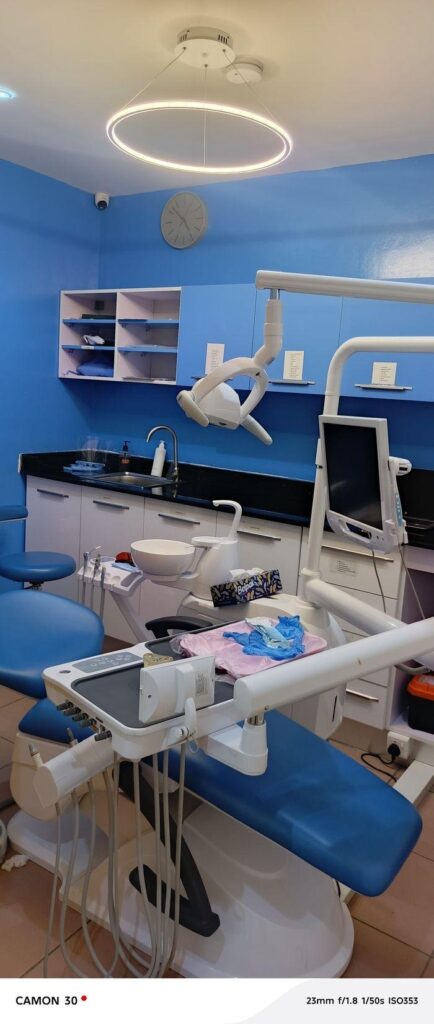
An orthodontic treatment room at Akcess Dental; digital imaging, LED lighting, and modern bracket systems for precise tooth movement.
When Should a Child in Ghana First See an Orthodontist?
The American Association of Orthodontists recommends a first orthodontic evaluation at age 7. That sounds early — and your child almost certainly won’t need braces at that age. But it’s the ideal time to spot developing problems.
At seven, a mix of baby teeth and adult teeth are present.
An orthodontist can identify early jaw growth issues, crowding that will worsen as more adult teeth erupt, crossbites that are easier to correct when the jaw is still developing, and habits like thumb-sucking that are affecting tooth alignment.
Intervening early (Phase 1 orthodontics) can sometimes reduce the complexity — and cost — of full braces later. Not every child needs early treatment, but every child benefits from early assessment.
Can My Teenager Get Ceramic (Clear) Braces Instead?
Yes. Ceramic braces are a middle ground between metal braces and Invisalign. They use tooth-coloured or clear brackets instead of metal ones, making them less noticeable while retaining the effectiveness and compliance advantage of fixed braces.
The trade-offs: ceramic brackets are more fragile than metal (slightly higher breakage rate), they cost more than metal braces (but usually less than Invisalign), and the clear elastic bands can stain if your teen drinks a lot of coffee, tea, or Fanta.
They’re a solid choice for teenagers who want less visible treatment but whose case needs the control that fixed braces provide.
What About Lingual Braces (Hidden Behind the Teeth)?
Lingual braces are brackets bonded to the back (tongue side) of the teeth — completely invisible from the front. They’re the ultimate stealth option.
However, they’re significantly more expensive than standard braces, require specialised orthodontic training, can affect speech temporarily, and are more difficult to adjust.
Availability in Ghana is limited to a small number of specialist clinics.
If your teenager is very concerned about visibility but their case requires fixed appliances, ask your orthodontist whether lingual braces are an option for their specific situation.
How Much Do Braces and Invisalign Cost for Teenagers in Ghana?
Most orthodontic clinics in Accra, including Akcess Dental, offer payment plans that spread the cost across the treatment duration. This makes orthodontic treatment accessible to more families.
Always ask about payment options at your consultation. Don’t let sticker shock stop you from exploring what’s available.
What Happens After Braces or Invisalign? The Retainer Phase
This section is critical — and it’s the one most parents overlook. After braces are removed or the final Invisalign tray is finished, your teenager must wear a retainer.
Without it, teeth will shift back toward their original positions. This is not a failure of treatment. It’s simply how teeth and bone biology work.
Fixed retainer: A thin wire bonded behind the front teeth. Invisible. No daily action required. Stays in permanently. Requires careful flossing around it.
Removable retainer: A clear tray worn at night. Similar to an Invisalign aligner. Must be worn consistently for the first 6–12 months, then as directed (often a few nights per week) indefinitely.
Many orthodontists recommend both — a fixed retainer on the lower front teeth (most prone to shifting) plus a removable retainer for nightly wear. The retainer phase is not optional. Skipping it is the single most common reason orthodontic results are lost.
Related Reading
→ Invisalign in Ghana: What Adults in Accra Need to Know (2026 Guide)
→ Dental Veneers in Accra: Composite vs Porcelain Guide
→ Your Child Is Scared of the Dentist: A Ghanaian Parent’s Guide